Banjo Lead Sheets: Your Secret Weapon Learning To Play
This post explains why banjo players should focus on developing musical fluency rather than relying on tablature, and introduces lead sheets as the perfect written tool for learning creatively. By reducing songs to melody, harmony, and rhythm, lead sheets let players build real musicianship instead of memorizing hand movements.
Published:
December 12, 2025
Updated:
December 22, 2025
Banjo Lead Sheets: Your Secret Weapon Learning To Play
Banjo players don’t use sheet music. Unlike classical musicians, players of bluegrass, old time, folk, Americana, etc. play music that comes from their minds, not from the printed page. And so the goal of learning the banjo isn’t to learn to sight read music, it’s to develop musical fluency.
That’s where you play music in the same way you have a conversation, in that you think of what you want to say and you say it! Just like having a conversation, playing music this way also feels much more natural than reading music off of a page. It’s also the way the vast majority of musicians have and continue to make music (despite the fact that many people today think learning music means reading music, often a product of childhood lessons in classical piano or violin).
The Tab Trap
However, this doesn't mean banjo players avoid written music entirely. Musical notation for banjo does exist, in the form of banjo tablature, or "tab."
Naturally, many beginners get the impression that the goal of learning banjo is learning to read tab, or that tab is the only way to learn new songs, which is definitely a mistake you want to avoid. Tab should not be the primary source of the music you learn (unless your goal is to learn to sight read!).
But this raises an important question: So, does that mean you should never use written notation of any kind?
Not at all.
Despite what some purists might say, you can absolutely use written notation to help you develop musical fluency more effectively. Fortunately, there is one kind of written notation that is absolutely perfect for that: the LEAD SHEET.
What is a Lead Sheet?
Stripped down to its essence, music is quite simple. Complexity in music, like complexity in just about everything else, comes from combining several simple elements together. All music, from folk ballads to complex symphonies, contains just 3 elements: melody, harmony, and rhythm. When an expert, fluent banjo player is playing a song, all they’re doing is taking those 3 elements of the song, its basic blueprint, and then transforming it using the techniques of banjo playing.
A lead sheet gives you exactly that basic blueprint–the essential features of a particular song that allow you to transform it into music on your own instrument. That’s much different than sheet music or banjo tabs, where the music tells you exactly what movements to make. Tab is like paint by numbers. Lead sheets are like painting from your imagination with some general guidelines to help (like “paint a landscape of a lighthouse on a cliff overlooking the ocean”).
Lead Sheets in Action
Let me show you how they work!
Here’s an audio clip of the folk song “Worried Man Blues.”
Now here’s the banjo lead sheet for that song. It has just the main melody notes and the chords (the rhythm is there too, but it’s easier to get that just from listening to the song).
If I just play this on the banjo, here’s what it sounds like:
It doesn’t sound like a banjo song yet, because I haven’t added any of the signature banjo elements. That part is up to me! And that’s what makes banjo lead sheets such an awesome tool - you’re not blindly mimicking how to play the song, you’re the one doing the creating. There are endless ways you can take that basic structure and turn it into a banjo song.
Here’s an example of a few different ways I could play that melody using the techniques of clawhammer banjo.
Here’s what that would look like in banjo tab. Notice how much more complicated that is!
You could learn it that way, but you’re making life way more difficult for yourself, and the only thing you’ll be learning are the movements of your hands needed to play that song exactly that way. It’s a path that virtually always leads to frustration and stagnation. Tabs might look like a shortcut, but if you use them as your primary learning source, they’re a shortcut to a place you don’t want to go.
Tabs are an effective learning tool when used properly - the problem comes when you use them as your main source for learning a song. When you learn from a banjo lead sheet, every time you learn a new song, you’re developing the full range of musical skills. You grow as a musician each and every time. In fact, over time you’ll find that you no longer need a lead sheet, or any form of written notation at all.
They may look simple, but lead sheets are one of the most powerful learning tools out there.
Tab vs. Lead Sheets - Side by Side Comparison
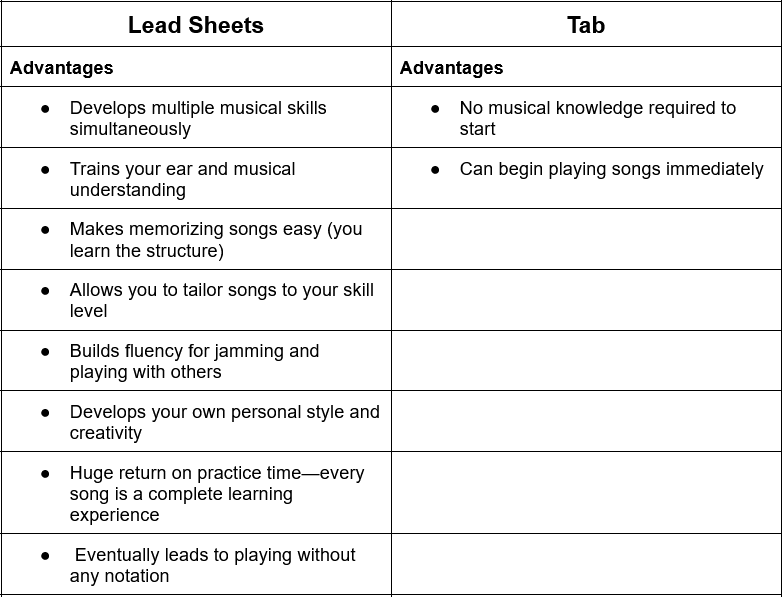
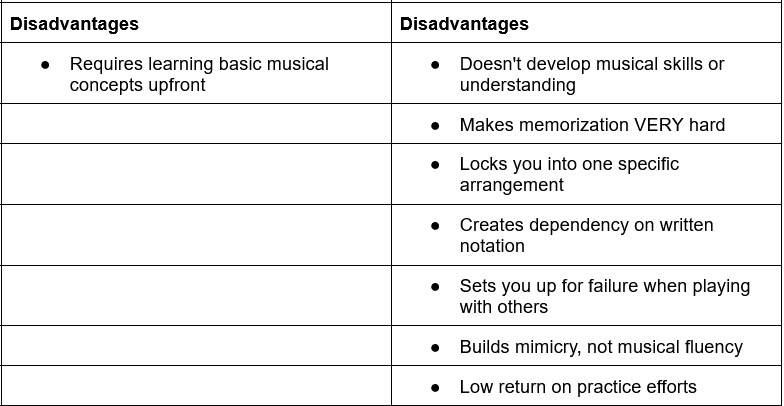
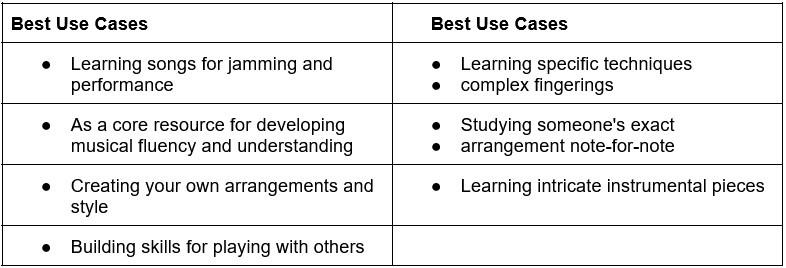
It should be super clear now why I use lead sheets throughout the entire Breakthrough Banjo course. You avoid all the common pitfalls from a “tab-first” approach, and start building musical fluency from day one.

.png)